


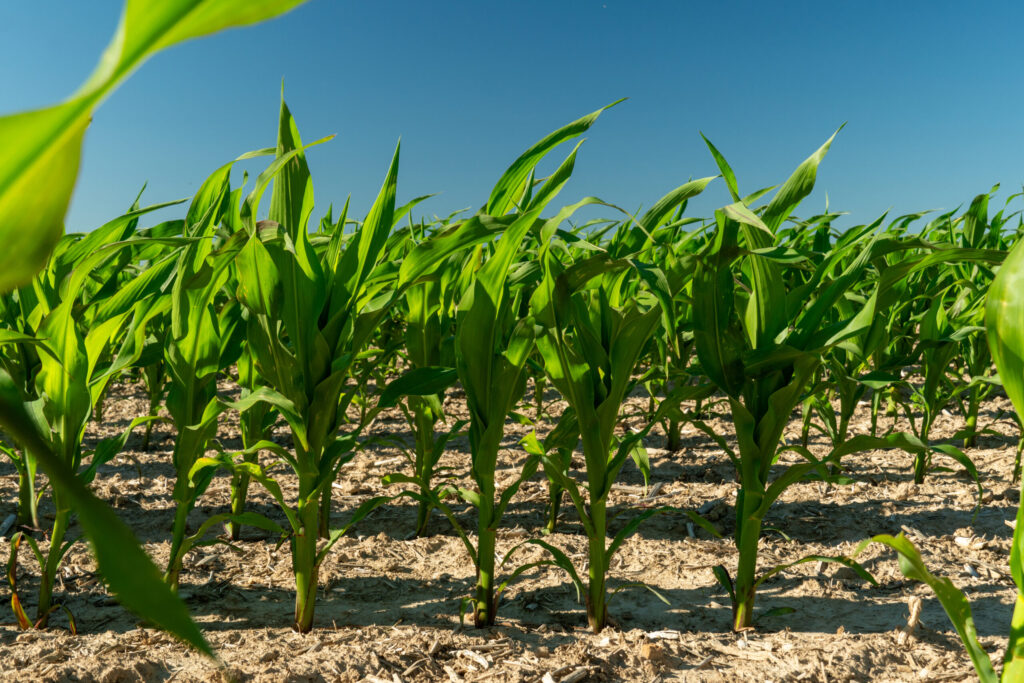
In corn, early season development plays a critical role in determining yield potential. From emergence through early vegetative growth, the crop establishes its root system, defines its uniformity, and begins setting the foundation for ear development. Stress or limitations during this period can have lasting impacts that are difficult to correct later in the season.
Emergence and Stand Establishment
Uniform emergence is one of the first indicators of early season success. Corn plants that emerge within a narrow window are more likely to compete evenly for light, water, and nutrients, resulting in a more uniform stand and eventual yield. Delayed or uneven emergence can lead to plant-to-plant variability that persists through the season and reduces overall yield potential. Due to corn’s low plasticity (ability to change physical characteristics in response to environmental conditions) studies have shown that uniform emergence is especially important for a high performing crop, with plants at one leaf behind showing a 20% reduction in yield, two leaves behind showing a 50% reduction in yield, and three leaves behind producing a barren plant. Those plants will never catch up to the plants that emerged on time. Modern growers target a 3 day window for corn emergence, and differences in this short window can have a major impact on yield. Several studies compiled by Pioneer show that during high stress events like drought, this short delay in emergence has an even greater impact, decreasing yields by an average of 16% by the fourth day.
Early-season soil conditions strongly influence emergence. Cool soils, excess moisture, and poor soil structure can all slow root growth and restrict nutrient uptake. Because young corn seedlings rely heavily on the developing root system, any factor that limits early root expansion can reduce early vigor and resilience.
Root Development Drives Early Growth
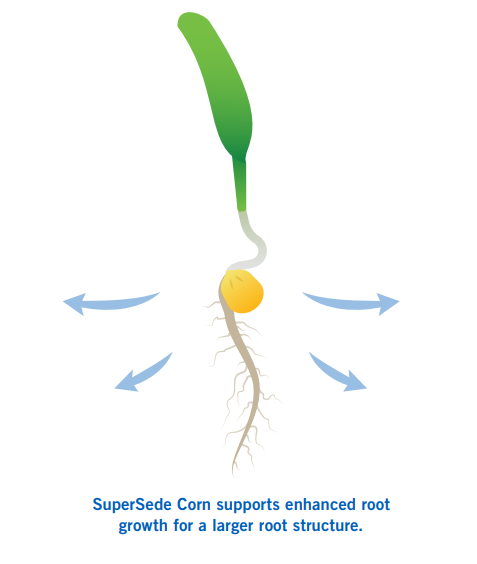
During the early vegetative stages, corn transitions from relying on the seed’s energy reserves to depending on its root system for water and nutrient uptake. Establishing a strong, seminal root system during this window is essential for supporting rapid vegetative growth and nutrient demand later in the season.
Nutrient availability during early growth is especially important. Phosphorus plays a key role in early energy transfer and root development, while zinc supports enzyme activity and growth regulation. Limitations in nutrient uptake can slow early development and reduce plant vigor.
SuperSede® Corn is a biostimulant seed treatment with complementary nutrition including boron, manganese, molybdenum, and zinc that increases germination and supports early root growth for uniformity and establishment. SuperSede Corn is a next-generation biostimulant that not only sets the crop up for enhanced physiological performance with our Transit® biostimulant, but also provides everything the crop needs to support that enhanced function with its complementary nutrient package. Check out our blog post for more on the Optimization Window.
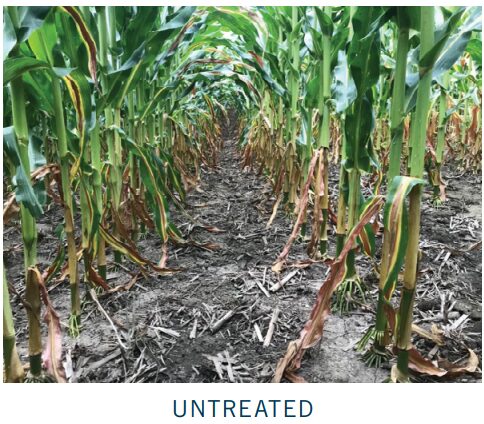
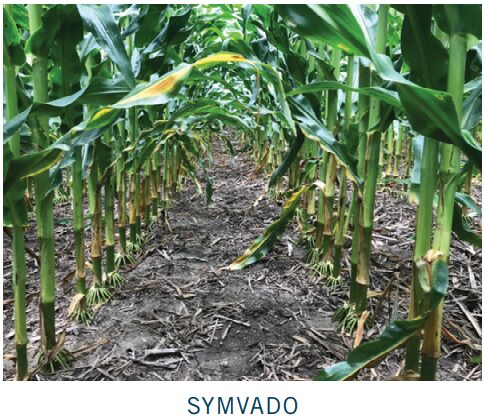
After initial root growth and establishment, season-long access to nutrients and water is critical for a high performing crop. Symvado® SC Mycorrhizal Inoculant is a liquid formulation powered by Mycoapply® arbuscular mycorrhizal fungi (AMF), extending the root absorption area by up to 48 times, enhancing access to nutrients and water throughout the season. AMF has also been proven to increase phosphorous availability and phosphorous levels in the plant.
Setting the Stage for Reproductive Success
While flowering and grain fill receive much of the attention later in the season, the groundwork for those stages is laid early. By the time corn reaches early vegetative growth, the plant has already begun determining ear size potential and kernel number. Early-season limitations can restrict these processes, reducing the ceiling for final yield regardless of favorable conditions later in the season.
Transit is a biostimulant that utilizes organic acids to support plant growth and nutrient translocation in the xylem and phloem. Once Transit is in the plant, it improves nutrient mobility. Foliar applications of Transit support increased leaf area for greater photosynthetic capacity.
During vegetative growth, expanding leaf area is one of the most important drivers of yield potential because it determines how effectively the crop can intercept sunlight and build carbohydrates. By helping nutrients move efficiently to developing tissues, Transit supports larger leaves and stronger canopy development. More complete leaf expansion early in the season allows the plant to capture more light sooner, fueling root growth, stalk development, and the formation of reproductive structures that follow. This early canopy advantage helps the crop fully express its genetic potential by building the photosynthetic engine it will rely on later in the season.
Building a Strong Start
Successful early-season development in corn is about more than just getting the crop out of the ground. Uniform emergence, strong root development, and efficient nutrient uptake during the weeks after planting create the conditions needed for consistent growth and higher yield potential. Investing in practices that support early vigor helps corn plants better handle stress, capitalize on favorable conditions, and carry yield potential through the rest of the season.