


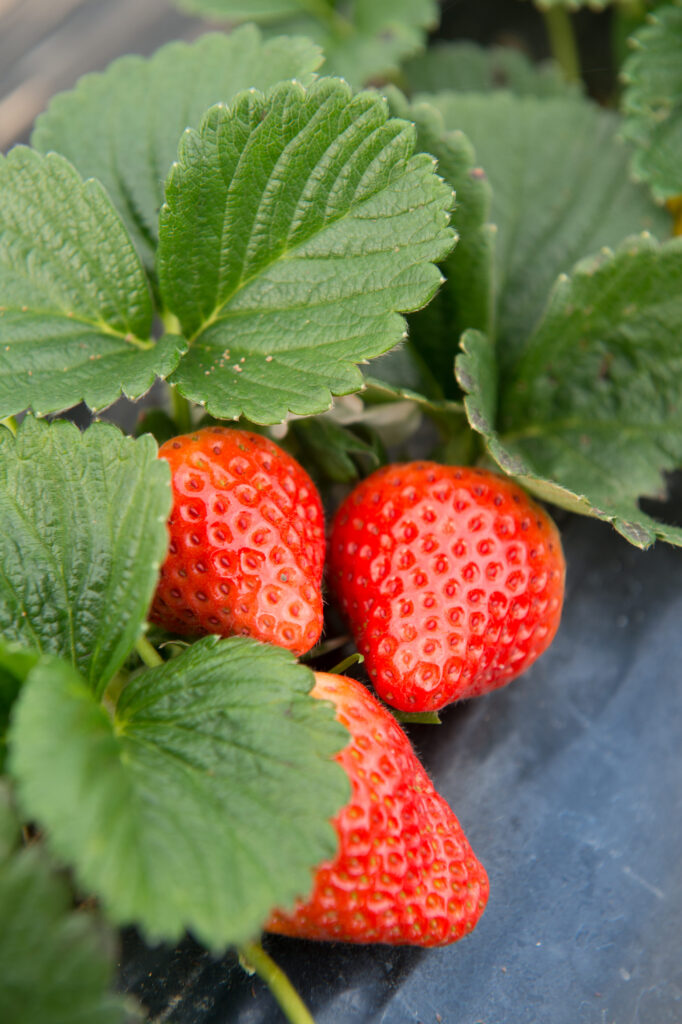
Strawberry genetics lay the foundation for fruit quality potential, but genetics alone don’t guarantee results in the field. Environmental stressors throughout the season can erode that potential, making it essential for growers to use tools that help protect and maximize fruit quality. Producing high-quality strawberries means balancing multiple quality goals at once: uniform fruit size, attractive color, and the sweetness consumers expect. For fresh market strawberries, the gold standard is USDA U.S. No. 1 grade, defined by strict requirements for size, uniformity, and color. Meeting this standard directly impacts grower profitability; in 2025, the average price for U.S. No. 1 strawberries was $1.43/lb., compared to just $0.41/lb. for processing strawberries.
Fruit Size:
Fruit size plays a critical role in strawberry marketability and pack-out efficiency. Uniform, market-preferred sizes fill clamshells cleanly with minimal gaps, while undersized fruit requires higher berry counts to reach weight, which increases handling times. Larger, more uniform berries also result in fewer picks per pound, and small fruit are more likely to be downgraded to processing and secondary markets.
Attractive Color:
Strawberry color has a major impact on consumer purchasing decisions and the bottom line for growers. According to a Utah State University Extension study, consumers ranked appearance second only to price as their highest priority when selecting strawberries. This translates to a higher income for growers. U.S. No. 1 grade strawberries require no less than three-fourths of the strawberry’s surface to show a pink or red color.
Sweetness:
Sweetness is also a critical factor in determining strawberry quality. Brix is a measurement of the percentage of sugar and other dissolved solids in fruit, directly indicating sweetness and maturity. For many consumers, sweetness is synonymous with freshness and quality. Research and consumer surveys consistently show that perceived sweetness strongly influences overall liking, with higher Brix levels closely tied to positive eating experiences.
Sweetsei™ is a biostimulant designed to support the desired balance of size, color, and sweetness by influencing key plant pathways involved in fruit ripening and coloring.
Containing a matrix of metabolic intermediates, macronutrients, and polysaccharides, Sweetsei works with the plant to improve fruit maturation, helping growers produce larger, higher-quality strawberries and more profitable harvests.
Sweetsei Supports Larger, More Marketable Strawberries
Sweetsei positively influences fruit sizing by supporting the physiological processes that drive fruit development and quality.
Components within Sweetsei help influence nutrient movement and metabolic activity during key stages of fruit growth. Potassium, in particular, supports cell expansion and carbohydrate transport, contributing to improved fruit size and more uniform development across the harvest window.
Enhancing Strawberry Coloration Through Key Plant Pathways
Color is often the first quality signal consumers notice. Sweetsei influences biochemical pathways responsible for the production of anthocyanins, the pigments that give strawberries their rich red color.
Phenylalanine, a metabolic intermediate included in Sweetsei, is a precursor in the shikimic acid pathway, which drives anthocyanin and flavonoid synthesis. By supporting these pathways, Sweetsei helps promote improved fruit coloration and a more visually appealing final product.
Promoting Sugar Accumulation in Strawberries for Better Flavor
Sweetness is a defining quality trait in strawberries desired by consumers, and sugar accumulation is closely tied to how efficiently carbohydrates are produced and transported to the fruit. Sweetsei supports the movement and accumulation of sugars within the plant, helping improve overall fruit flavor.
By enhancing metabolic efficiency and nutrient availability, Sweetsei helps optimize the sugar-to-acid balance in developing fruit, supporting sweeter, more palatable strawberries that meet consumer expectations.
Backed by Field Trials
Sweetsei performance has been evaluated in U.S. field trials across fruit crops, demonstrating consistent improvements in fruit quality attributes including sizing, color development, and sugar accumulation. These results reinforce Sweetsei’s role as a reliable tool for enhancing fruit maturation and overall harvest quality under commercial growing conditions for strawberries.
Flexible Application Options
Sweetsei offers application flexibility to fit a variety of strawberry production systems. It can be applied as a foliar spray, through surface drip, or via subsurface drip irrigation, allowing growers to integrate it easily into existing management programs.
To learn more about Sweetsei and how it can support strawberry quality, contact your Valent BioSciences representative or visit the Sweetsei product page.